As an athlete, you live for the game, the race, or the next heavy lift. An injury is more than a physical setback — it pulls you away from your goals, your training, and your community. When you are sidelined, the first question is almost always: "How long until I'm back?" At The Mobile Athlete in Peachtree City, GA, we understand that urgency. Our goal is not just to get you out of pain, but to bridge the gap between rehab and peak performance so you can return to your sport stronger and more resilient than before.
Understanding the Healing Timeline: Why Results Vary
Recovery is not a linear process. Biological healing follows a specific timeline that cannot be rushed, and understanding those phases helps set realistic expectations from day one.
Generally, your body moves through three primary stages. The acute phase involves inflammation and initial pain management. The subacute phase is where the real tissue repair work begins. Finally, the remodeling phase is where we focus on rebuilding strength and restoring full function.
Several factors influence how quickly you move through these stages:
- Injury severity (a mild hamstring strain versus a full ACL tear, for example)
- Age and overall health history
- Nutritional habits and sleep quality
- Previous training history and baseline fitness
Performance physical therapy in Peachtree City focuses on optimizing these biological windows. While the healing steps cannot be skipped, every session at The Mobile Athlete is designed to ensure you are making the most of each phase without unnecessary delays.
Common Injuries and General Recovery Timelines
While every athlete is different, general windows exist for the most common athletic injuries. These ranges are starting points, not guarantees, and your individual plan will be shaped by objective data and ongoing assessment.
Soft Tissue Injuries
Strains and sprains — including hamstring strains, ankle sprains, and groin injuries — often see a return to sport in roughly 4 to 12 weeks. The early weeks are critical. Proper loading during this window ensures the tissue heals with the tensile strength your sport demands.
Joint and Overuse Injuries
Conditions like runner's knee (patellofemoral pain), shoulder impingement, IT band syndrome, and Achilles tendinopathy typically require 6 to 16 weeks of consistent work. These injuries often stem from underlying movement dysfunctions that must be addressed at the root to prevent recurrence.
More Complex Injuries
ACL injuries, labral tears, and post-surgical rehabilitation generally require a longer, more carefully staged progression. Return-to-sport timelines for these injuries are guided by objective strength and performance benchmarks rather than a fixed calendar date.
The Advantage of Data-Driven Physical Therapy
At The Mobile Athlete, we remove the guesswork from your recovery. Traditional approaches often rely on subjective feedback alone, but athletes need objective benchmarks to know they are truly ready to return.
Our clinic uses force plate testing and VALD testing to measure strength, power, and movement deficits with precision. These tools answer critical questions: Is your left leg producing less force than your right during a jump landing? Is your grip strength lagging after a wrist injury? Is your hip producing the power needed for your sport?
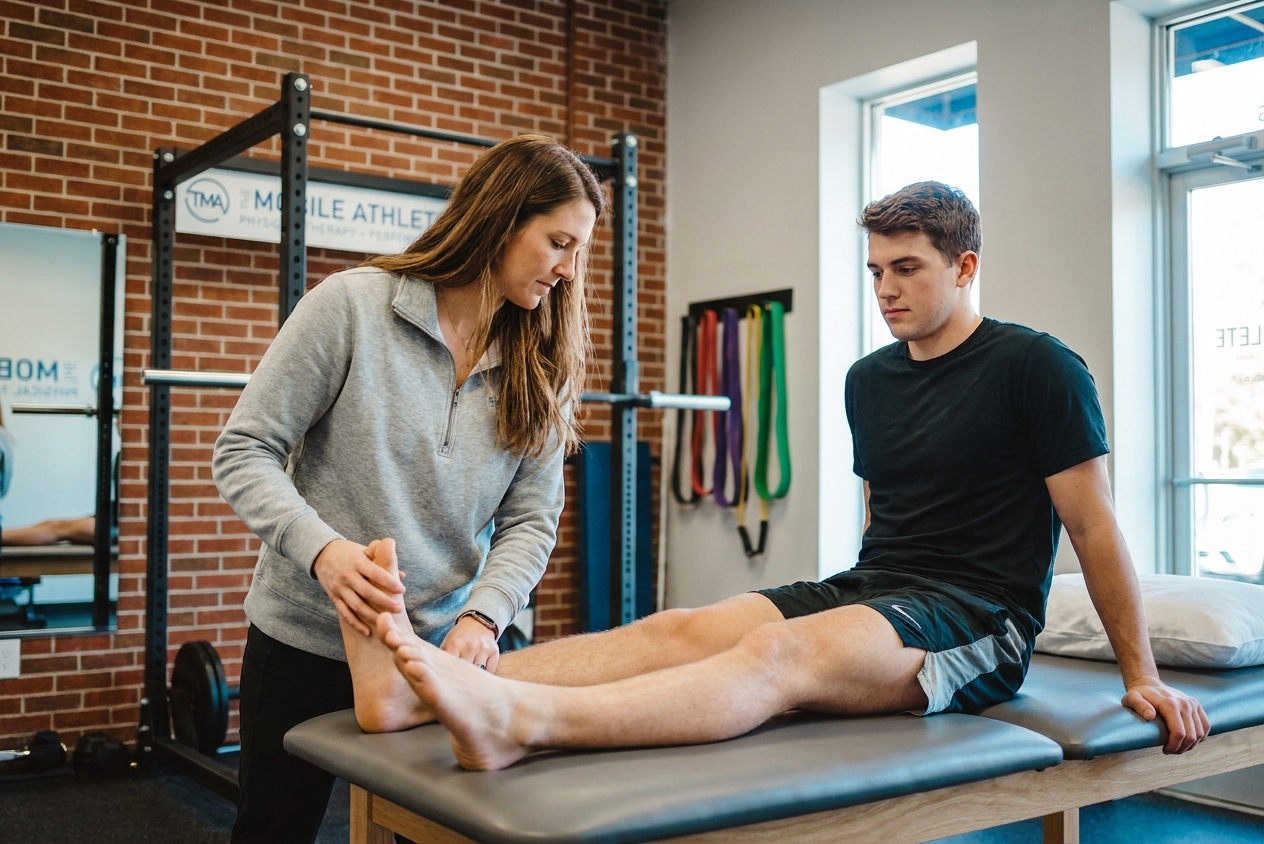
With that data in hand, we build a targeted plan rather than a generic one. Every session is also delivered as one-on-one care — you will not be handed off to an assistant or share your time with multiple other patients. That dedicated focus means we catch the small details that accelerate recovery and ensure every exercise is performed with the precision high-level performance demands.
How Evidence-Based Modalities Support Faster Recovery
The right modalities, applied at the right time, can meaningfully accelerate the early phases of healing and get you back to loading sooner.
Dry needling is a powerful tool for releasing stubborn trigger points, reducing localized pain, and resetting muscle function. By calming the nervous system, it allows you to move through a greater range of motion earlier in the recovery process.
Blood flow restriction (BFR) training is particularly valuable for athletes limited by pain or post-surgical precautions. BFR allows you to achieve meaningful strength and muscle retention using significantly lighter loads — keeping your muscles strong and preventing atrophy even when a joint is not yet ready for heavier resistance.
Additional modalities available at The Mobile Athlete include:
- Manual therapy and soft tissue mobilization
- Cupping and scraping
- Trigger point therapy
- Electrical stimulation (TENS/NMES)
- Compression therapy
- Neuromuscular re-education
.jpg)
Why Recovery Does Not End When the Pain Does
Many clinics discharge patients as soon as they can move without discomfort. At The Mobile Athlete, being pain-free is the beginning of the process, not the finish line.
Returning to sport before your tissue is truly ready — simply because the pain has subsided — significantly increases your risk of re-injury. Our approach is to build a clear bridge from rehabilitation to full performance by addressing the movement patterns and strength deficits that contributed to the injury in the first place.
That progression includes plyometrics and return-to-sport progressions that mirror the actual demands of your competition, as well as return-to-sport testing using our force plate and VALD technology to confirm you are objectively ready before you step back onto the field, court, or platform.
Building Long-Term Resilience Through Strength and Conditioning
For athletes who want to stay healthy long after their injury has resolved, The Mobile Athlete offers strength and conditioning and performance training designed to build the capacity needed to remain active for the long term.
Whether you are recovering from a chronic overuse injury, preparing for a season, or focused on injury prevention, our performance-focused programming provides the expert guidance and progressive structure needed to keep you performing at your best.
If you are tired of generic care and want a plan built around your athletic goals, it is time for a different approach. Contact The Mobile Athlete in Peachtree City, GA to schedule your evaluation and start your data-driven return to the sport you love.